
About 178 million American adults are missing at least one tooth, and roughly 40 million have no natural teeth remaining. So if you are living with a gap in your smile, you are in wide company, and there is no reason to feel embarrassed about it. Tooth loss does reach beyond appearance and confidence, though. Over time it can lead to bone loss in the jaw and make good nutrition harder, which is why replacing a missing tooth is worth doing rather than putting off.
The two most common replacements are dental bridges and dental implants. Both are legitimate options, and the right one depends on your mouth, your priorities, and a conversation with your dentist, never on pressure. Here is a plain side-by-side look at how each one works.
How a dental bridge works
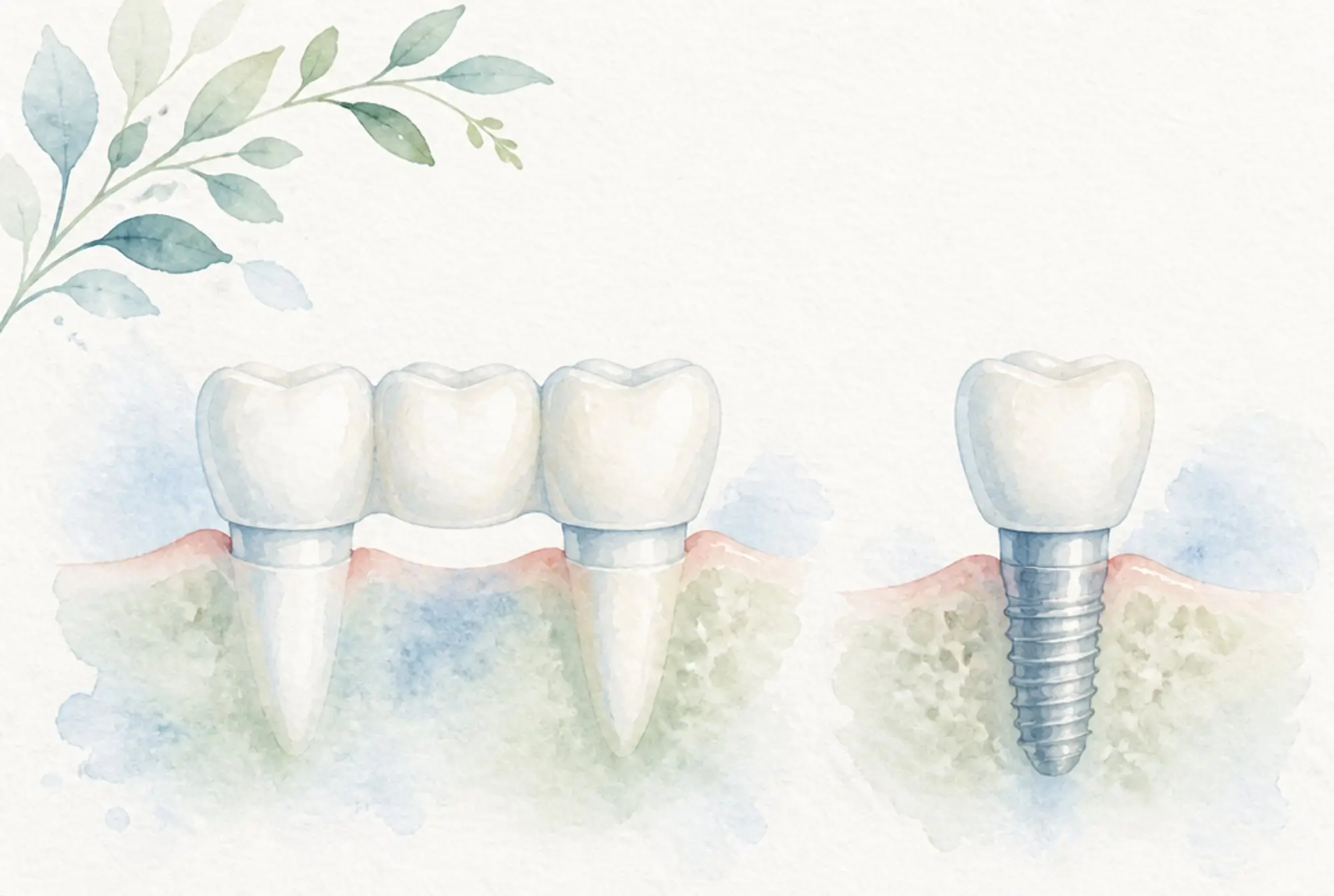
A dental bridge replaces one or more missing teeth by spanning the gap. On either side of the space, the bridge is bonded securely to your remaining natural teeth, which serve as its anchors. The replacement tooth in the middle is shaped to look natural and is usually made of porcelain.
Many patients choose a bridge because it is the more affordable option up front, and that is a fair reason. The tradeoffs show up over time. A bridge typically needs to be replaced after some years of wear, and because the anchor teeth carry the pressure of the bridge, those neighboring natural teeth face a higher risk of decay and damage.
How a dental implant works
A dental implant is built from three parts: a post, an abutment, and a crown. The post is anchored within the jawbone beneath the gum line, the abutment sits on top of it, and the natural-looking crown attaches to the abutment.
Because the post is anchored in bone, an implant is a far more permanent solution than a bridge. It looks, feels, and functions like a natural tooth, and it stands on its own, so there is no added risk of damage to the teeth beside it. The post also keeps the jawbone active, which helps preserve bone density and reduces the risk of the bone loss that follows a missing tooth.
The comparison in plain terms
- Up-front cost. A bridge costs less at the start. An implant is a larger initial investment.
- Lifespan. A bridge lives on a replacement schedule. An implant is designed to stay put.
- Neighboring teeth. A bridge depends on the teeth beside the gap and puts pressure on them. An implant leaves them alone.
- The jawbone. An implant preserves bone density from within the jaw. A bridge sits above the gum line and cannot do that.
Neither answer is universal. For some patients a bridge is the sensible choice, and for others, particularly those missing several teeth, dentures are a third path worth discussing.
Talking it through in Carmel
At Smile Arts Dental, sorting out which restoration fits you starts with an exam and an honest conversation, not a sales pitch. Dr. Alex Balaban focuses on restorative dentistry and is a member of the Perio Institute of Implantology. He is also a member of the Dental Organization for Conscious Sedation, which reflects the Fear-Less Dentistry approach the practice is built on: if dental work makes you anxious, comfort comes first at every step. To find out whether an implant, a bridge, or another option is right for you, request an appointment online or call (317) 575-1995.
This article is for general education only and is not a substitute for professional dental advice. For guidance about your own smile, talk with your dentist.